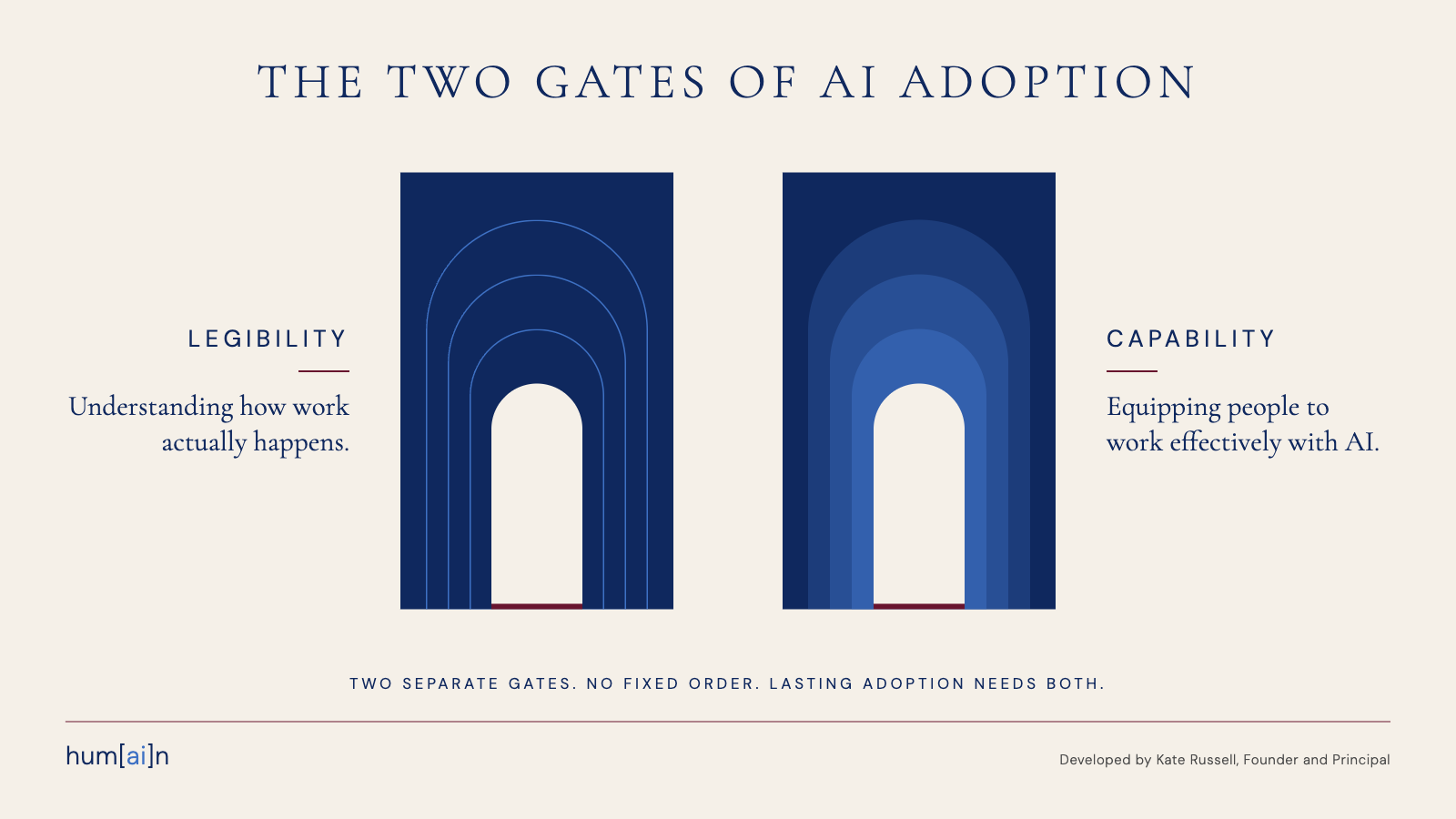
The two gates are separate and can be opened in either order, but lasting AI adoption needs both, and the one most organisations never name is legibility.
Three months after the AI training wrapped up, a leadership team sits down to review what has changed. The sessions were well attended, the feedback was warm and a good number of people now use the tools most days, yet the monthly report still takes the same week to pull together, and it still depends on the one person who knows which spreadsheet holds the right number.
It is a situation that I, as founder of hum[ai]n, see regularly in mid-sized and large organisations, and the usual responses are to question the tool or to book another round of training. Neither tends to help, because the training did its job, and the thing holding the organisation back sits somewhere the training was never designed to reach.
I describe this as the Two Gates of AI Adoption. Before AI changes how work gets done in any lasting way, two separate things have to be true: the work has to be legible, and the people doing it have to be capable. Most organisations put their effort into the second and never name the first.
Gate One: Legibility
Legibility is whether someone outside one person's head can follow how the work actually happens. A process map is a start, but most of what makes work run lives outside it: the tacit knowledge a long-serving team member carries, the decisions made along the way and who makes them, the dependencies on other teams, and the judgement calls nobody has written down because nobody has ever needed to.
When that understanding lives only in people's heads, a term can mean slightly different things to different people and the current version of a number can live in three places at once. A new hire in that environment takes months to find their feet, and AI fares no better, except that it guesses with confidence and gets it wrong.
Most organisations think they have an AI adoption problem, when what they actually have is a legibility problem wearing an AI costume.
Gate Two: Capability
Capability is whether people can work well with AI once they have it, which asks for a good deal more than access to a tool and a few prompting tips. People need to understand what AI is doing, brief it with intention, check what comes back against a real standard, and know where their own judgement has to stay in the loop. Leaders need enough of the same grounding to make informed decisions and to give their teams room to experiment responsibly.
This is the gate that training opens. In the hum[ai]n Compass it is the work of the Capability Building stage, where the Four Skills Framework teaches people to think with AI using real workflows from their own team.
Separate gates, no fixed order
The two gates are distinct, and they don't have to be opened in a particular order. An organisation can start building capability today, in imperfect conditions, provided a person stays across the output and human judgement sits between the draft and the decision. Another might begin with legibility, because a restructure, a new system or the departure of a key person has already forced the question of how the work really runs.
Where organisations come unstuck is in treating one gate as the whole job. Capability without legibility produces confident people working on top of a process nobody has examined, so the gains stay with individuals and stall at the level of the team. Legibility without capability produces a well-understood process that nobody yet has the skill or confidence to do differently. The further an organisation wants to go, particularly towards handing whole pieces of work to AI, the less optional Gate One becomes.
Training makes people more confident, but it does nothing to make the process underneath them more solid, and only one of those gets fixed in a workshop.
Where the gates sit in the hum[ai]n Compass
The hum[ai]n Compass sets out the five conditions for AI adoption, and the cultural thread that runs through them. Gate Two sits squarely in Capability Building. Gate One is leadership work that runs through the earlier stages: agreeing in Foundations and Leadership Alignment how the work happens and who owns it, and deciding in Governance and Guardrails what data and which decisions can go near a tool. That is why legibility can't be handed to a data or technology team to sort out on the organisation's behalf.
Questions for leadership teams
Legibility
- Could someone outside the team follow how this work actually gets done?
- Do we all mean the same thing by the terms we use, and do we know where the current version of each number lives?
- Do we know which decisions rely on judgement that has never been written down?
Capability
- Can our people brief AI with intention and check what comes back against a real standard?
- Do they know where they need to stay in the loop?
- Are our leaders equipped to guide adoption and support new ways of working?
Start with either gate
An organisation doesn't need both gates fully open before it starts, and it can begin with whichever one is closer to hand. What it can't do is train its way past work that nobody has made legible, because the same adoption problems will keep coming back however many workshops it runs.
AI works when people do.
Kate Russell is the Founder and Principal of hum[ai]n, an Australian AI adoption advisory, and developed the Two Gates of AI Adoption.